
 12 May, 2026 • 5 minute read
What a private deal room should actually contain
A deal doesn't happen inside folders. It happens in the questions around the files, the redlines, the follow-ups, the side comments, the decisions, and the small next steps that keep things moving.
When those pieces leak out into email, chat, calls, and shared links, the deal room becomes a storage layer and nothing more. The real work is still scattered.
A private deal room should do more than hold files. It should give buyers, sellers, counsel, advisors, and clients one controlled place to work through the deal together.
Here's what that means in practice.
1. The current deal documents
This sounds obvious, but it's where a lot of processes fall apart.
A private deal room should make it clear where the current file lives. Not three versions in three folders. Not an attachment called final_v3. Not a document someone emailed around after the room was set up.
It should hold the materials people actually need to review:
- financial documents
- contracts
- cap tables
- corporate records
- diligence materials
- draft agreements
- redlines
- disclosure schedules
- closing documents
The test is simple. When someone asks "where's the latest version?", the answer should be obvious. If people are still digging through inboxes and comparing filenames, the room isn't doing its job.
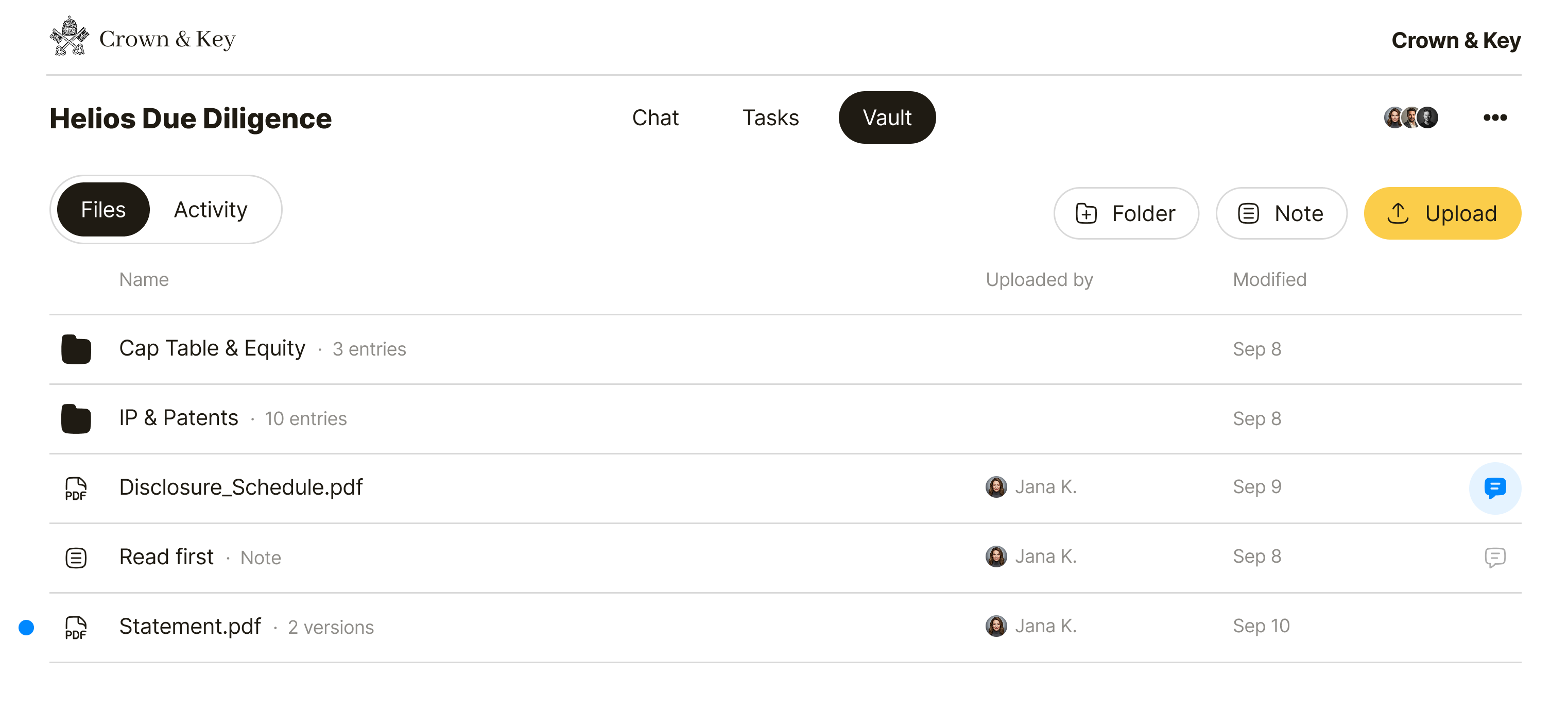
A private deal room keeps one clear home for every document, so "where's the latest version?" has an obvious answer.
2. Questions tied to the work
In most deals, the documents are only half the job. The other half is questions.
A buyer asks about a contract. Counsel wants a clarification. An advisor needs supporting material, or someone notices a missing document and asks whether a clause has changed.
When those questions live in email, the deal gets harder to manage. The file sits in one place and the conversation about it sits somewhere else.
A good private deal room keeps the two together. If a question is about a file, you should be able to ask it right next to that file. And if a reply matters three weeks later, it shouldn't be buried in someone's inbox.
That's cleaner to work with, and it leaves the team a far better record of what happened.
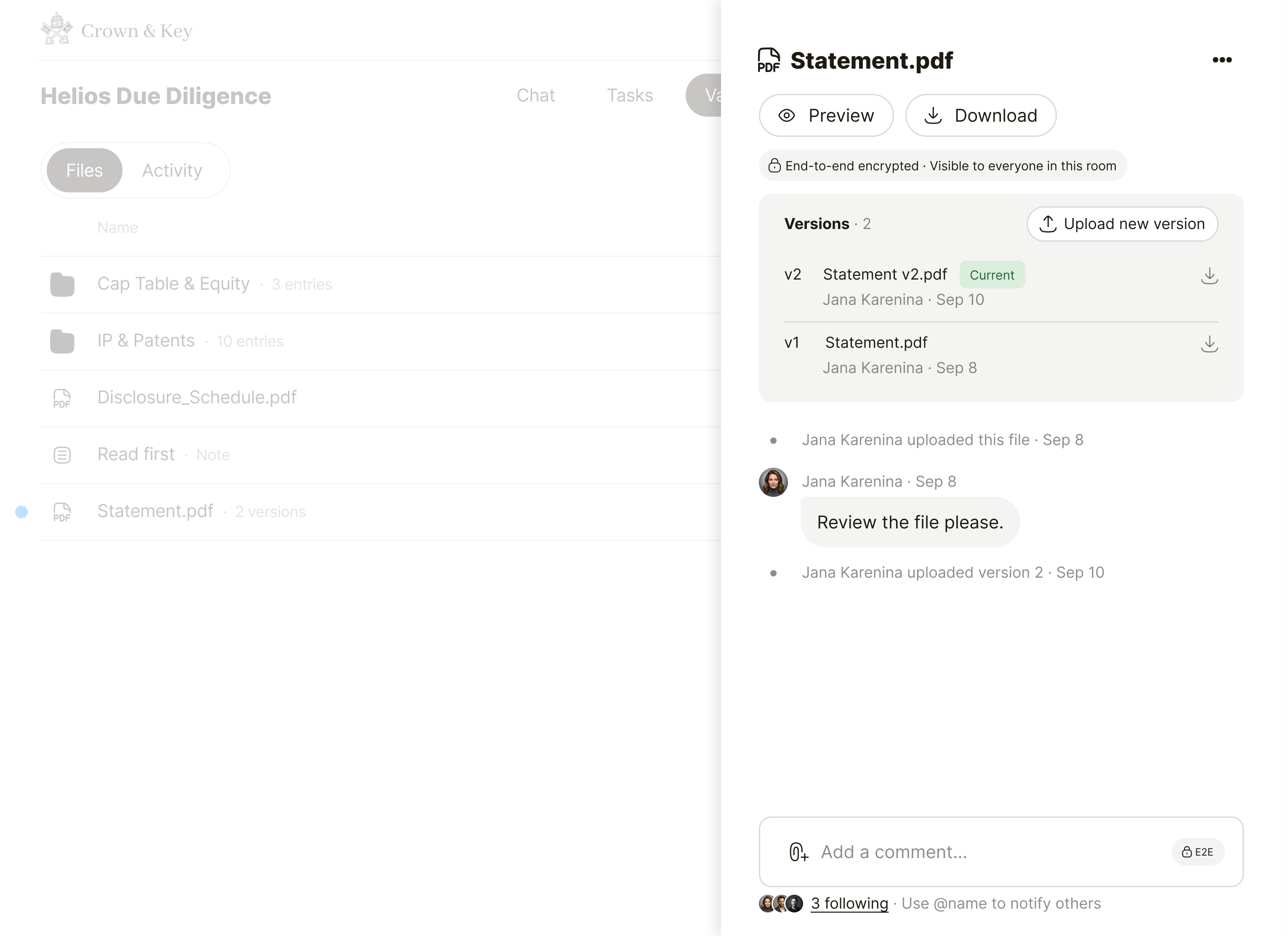
The conversation lives on the file: comments, version history, and who's following all stay attached to the document — not buried in an inbox.
3. Clear next steps
Most deals don't stall over one big issue. They stall because small open items are unclear: who's uploading the missing document, who's reviewing the redline, who's waiting on counsel, what's already been handled.
A private deal room should make those next steps visible.
Not every deal needs full project management. But every deal needs an easy way to see what's open, who owns it, and what happens next. Without that, people end up running the deal through follow-up emails and calls, and that's exactly when things slow down.
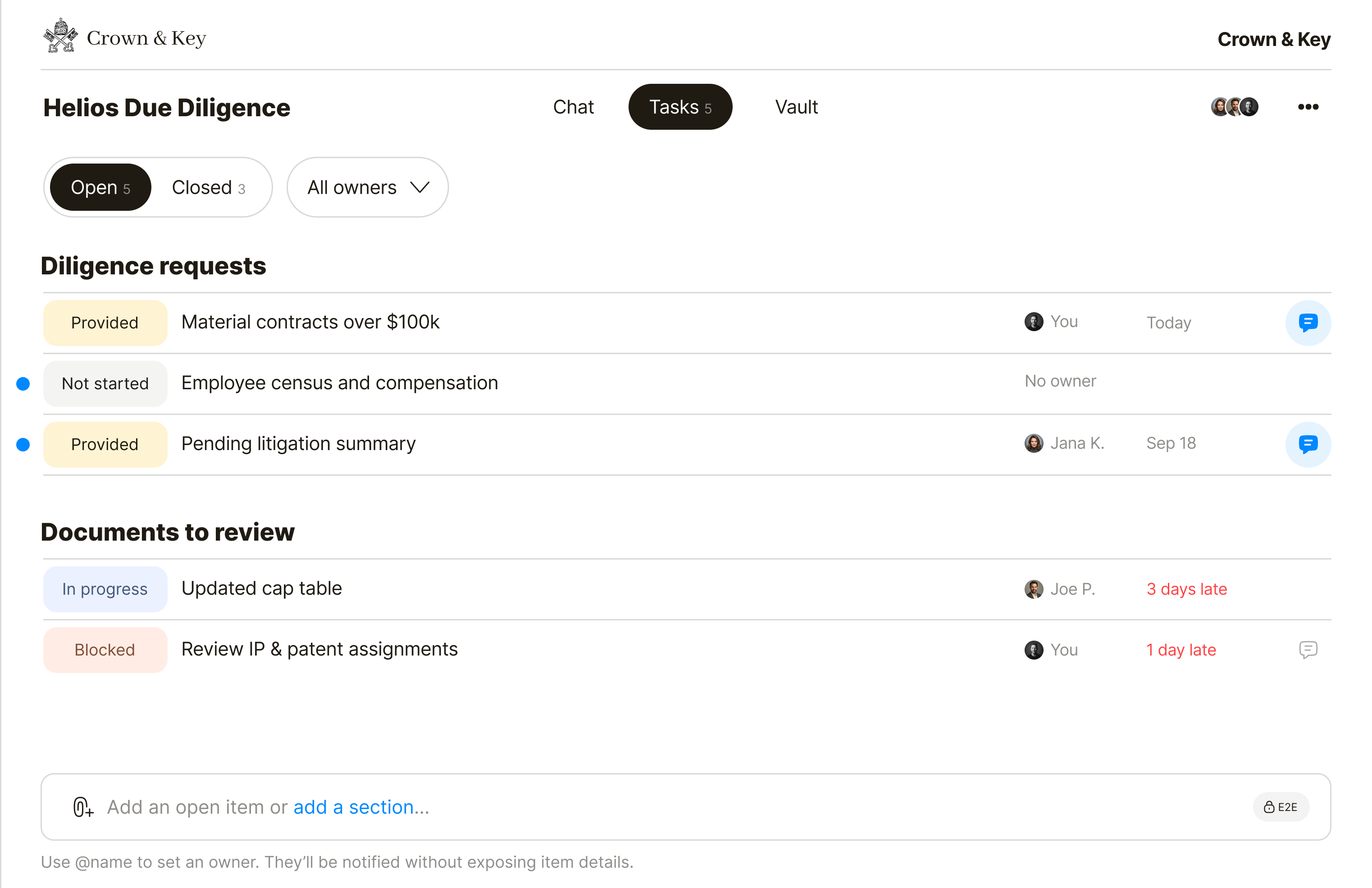
Every open item has an owner, a status, and a due date — so it's always clear what's outstanding and who's on it, without chasing email.
4. Decisions and sign-offs
Deals get messy when everyone thinks something was agreed but nobody can point to a clean record.
"Looks fine" isn't always a decision. "Let's proceed" isn't always a sign-off. A passing comment on a call may not hold up later.
In a private deal room, decisions and sign-offs should stay connected to the work. That doesn't mean every room needs a heavy approval workflow. In most transactions, what matters is simpler: what was reviewed, what changed, who responded, what was agreed, and what still needs confirming.
The point is to never have to reconstruct the deal from scattered messages after the fact. For sensitive work, that decision trail matters.
5. Controlled participant access
A serious deal room brings in outside parties: the buyer, the seller, legal counsel, tax advisors, investors, board members, consultants, clients. External access is normal. Losing track of it isn't.
A private deal room should make access clear from the start — who's in the room, what they can see, who invited them, and whether their access can be pulled the moment the deal changes.
The right people should be able to join quickly, ideally straight in the browser, with no heavy onboarding. But quick to join shouldn't mean easy to lose control of. The standard is simple: easy to enter, hard to lose track of.
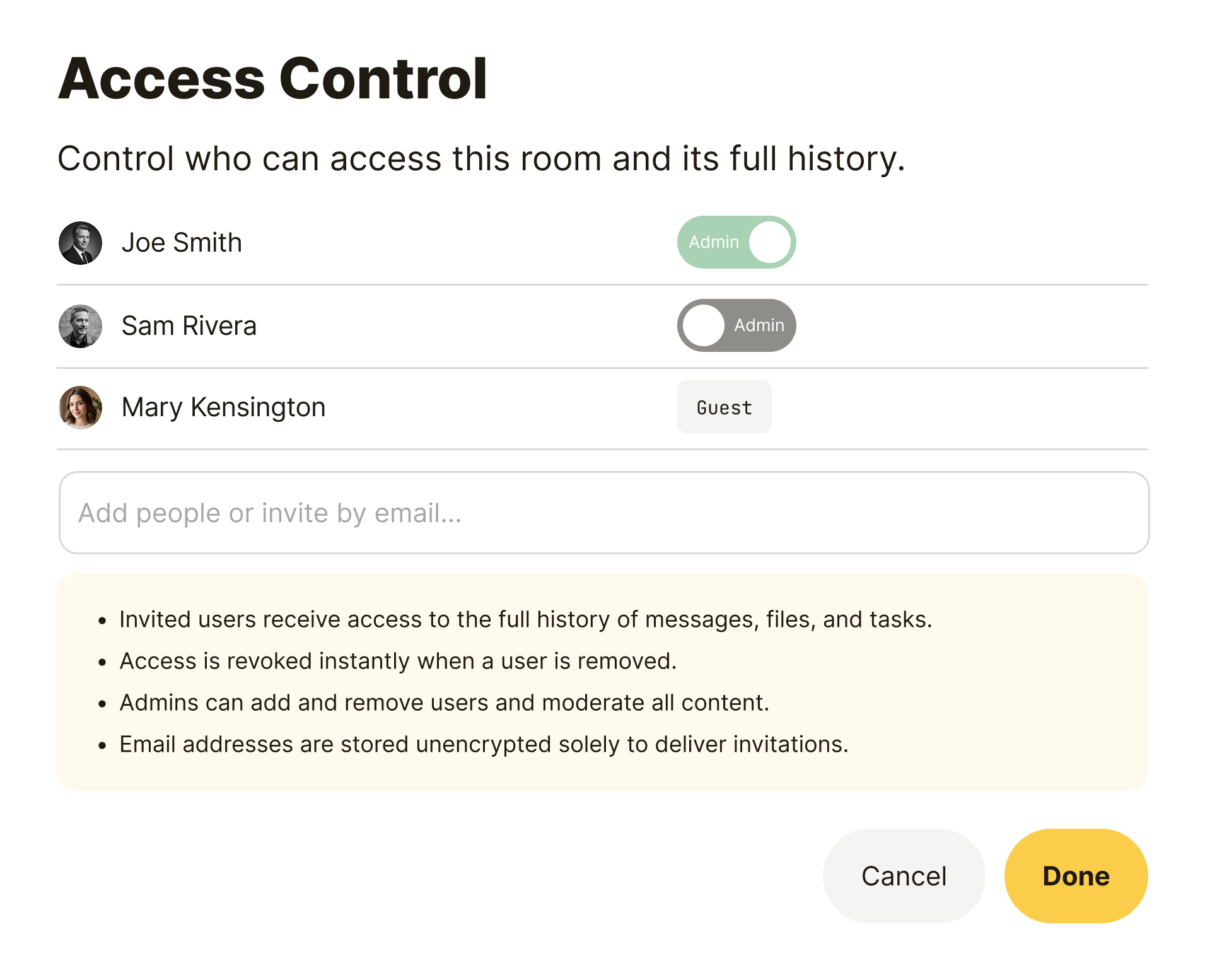
Access control — stays explicit, so the room owner decides who enters and who can see its history.
6. Security built into the room
Security shouldn't be an add-on in deal work.
Financials, contracts, diligence files, redlines, board materials, internal notes, negotiation details — these aren't ordinary documents, and they shouldn't travel through forwarded links and convenience tools without real protection.
By default, a private deal room should protect the work. At a minimum, that means clear access boundaries and controlled participation. For more sensitive deals, safe storage isn't enough on its own. The room should be built so confidential material stays protected as it moves through the process, not only while it sits in a folder.
So the real question isn't "where are the files stored?" It's "who can read the files, the messages, the comments, and the decisions inside the room?" That's the point where security stops being a feature and becomes part of how the work happens.
7. A simple experience for outside parties
This one is easy to underestimate.
A deal room can be perfectly secure and still fail in practice if outside parties don't use it. Buyers, counsel, advisors, and clients don't want a long setup, training, or an app to install just to review a document, ask a question, or confirm a next step.
If the room feels heavy, people quietly fall back to email.
That's why simplicity matters. An outside participant should be able to walk into a private deal room, see where everything is, and start working without anyone holding their hand. That's not only about usability — it's about deal speed. The easier the room is to use, the more likely the deal stays inside it.
What a private deal room should contain
Pulling it together, a useful private deal room holds:
- the current deal documents
- file-specific questions and replies
- clear next steps
- decisions and sign-offs
- controlled participant access
- security built into the workflow
- a simple experience for outside parties
The best deal room isn't the one with the most features. It's the one that keeps the deal together — the files, the questions, the decisions, the next steps, and the right people all in the same place.
And the sensitive work stays inside a controlled room, instead of spreading across inboxes, cloud links, calls, and side channels.
That's what a private deal room should actually contain. Not just storage, but the whole deal in one place.