
 18 Jun, 2026 • 4 minute read
What is a deal room?
That model doesn't scale anymore. Deals now involve teams in different countries and information that changes by the hour. The physical room moved online.
A virtual deal room is a secure online space where everyone working on a transaction comes together. It holds the documents, the questions, the decisions, and the next steps in one place, instead of scattered across email threads, chat apps, and shared links nobody really controls.
What's actually inside a deal room
A deal room isn't just a folder.
A folder holds files. A deal is made of more than files, though. It's made of everything happening around them, and a deal room keeps that whole story together.
Here's what that includes:
- The latest documents. Financials, contracts, due diligence material, redlines, disclosure schedules, and draft agreements.
- The conversation. Buyer questions, clarifications from counsel, and the follow-ups that have to be answered before the deal can move.
- A record of what happened. Who changed what and when, with notifications so nothing slips past you.
- The work itself. Real tasks you can track, so it's always clear what's still open.
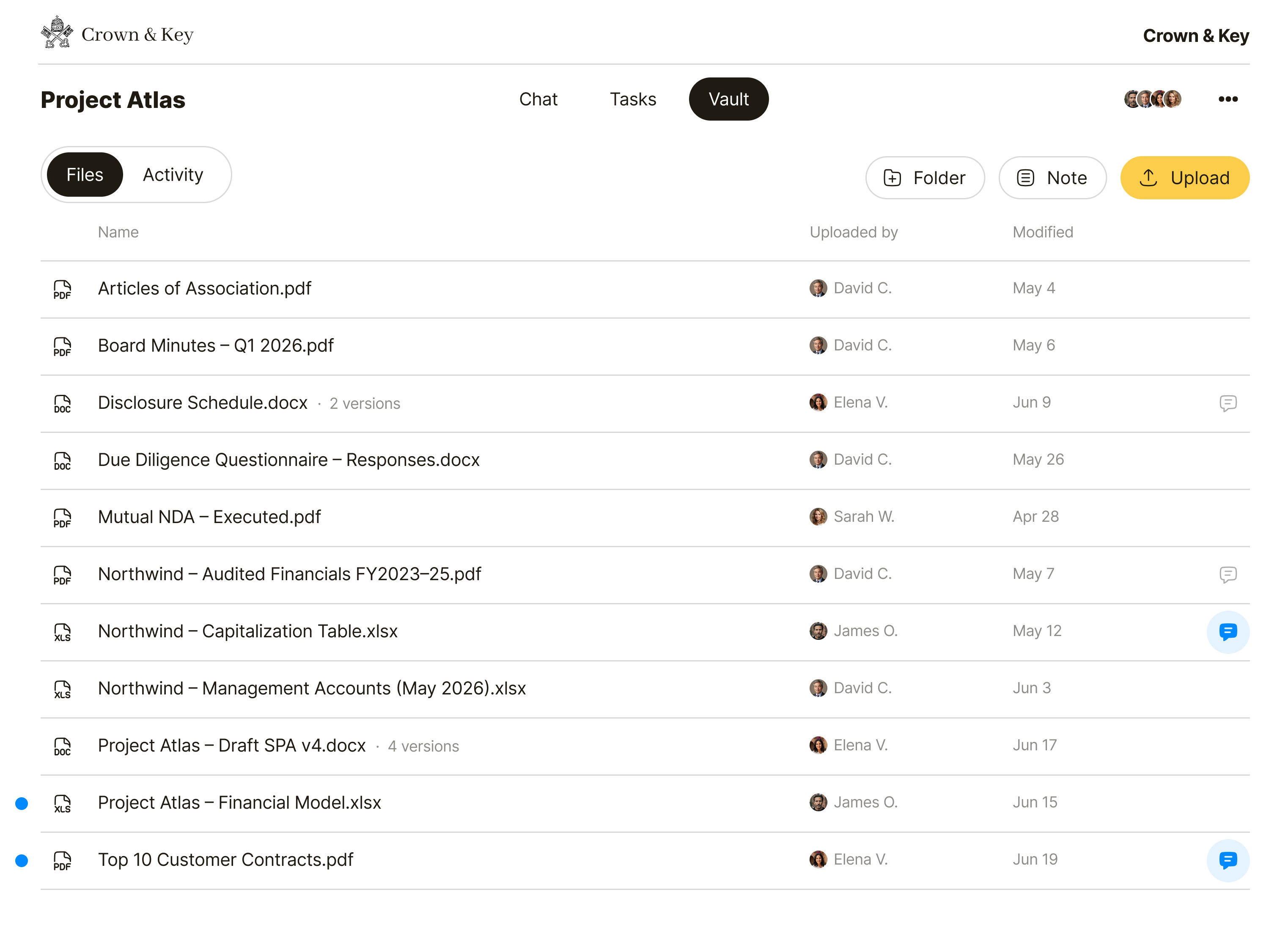
More than a folder — a deal room holds the documents and the conversation around them.
When all of this lives in one place, deals move. When it's spread across inboxes, personal drives, and phone calls, deals stall.
Who needs a deal room?
Lawyers are bound by a duty of confidentiality. For them, a private deal room isn't a convenience. It's part of the job.
Client communications, deal documents, and strategy are all privileged. Sending them over regular email or a general-purpose cloud tool isn't a grey area, it's a liability.
That includes:
- Law firms handling due diligence and document review
- M&A advisors running buy-side or sell-side processes
- Private equity and venture capital teams during an investment
- Insurance professionals dealing with sensitive policy and claims files
- Founders and executives closing a funding round or an acquisition
Notice what these roles have in common. It isn't the industry, it's the complexity of the deal. Once a transaction involves confidential material, outside parties, and more than a couple of moving pieces, it belongs in a deal room.
Deal room vs. virtual data room
People use these two terms as if they mean the same thing. They don't.
A virtual data room (VDR) is a secure place to store documents. It's built for holding and sharing large volumes of files during due diligence, with permissions, watermarking, and access logs. For managing documents at scale, it's the right tool.
A deal room covers more ground. It follows the whole transaction, from open to closed.
Due diligence is only one stage of a deal. Most of the work happens outside document review: lining up advisors, tracking open questions, managing who has access, and working through the closing steps.
In a document-heavy process, a deal room doesn't replace your VDR. It sits on top of it and handles what the VDR can't: the communication, the coordination, the decisions, the client handoff, and the final sign-off that moves a deal across the line.
The trouble with email
When there's no proper place to do the work, deal teams fall back on email. It's familiar and fast, and it creates quiet problems.
Email gives you no real control over access. A forwarded message reaches someone who was never meant to see it. A reply-all pulls in the wrong people. Attachments multiply until nobody is sure which version is current.
Email is also a poor record. Try reconstructing when something was agreed, who confirmed it, or what changed between two drafts. From an inbox, that's close to impossible.
For a sensitive deal, the real question goes beyond whether your files are stored safely. It's whether the entire process happens somewhere secure: the discussion, the decisions, and who can get in. Email isn't that somewhere.
What makes a deal room secure
Security isn't only about where files are stored. It's about where everything else happens too. That's the reason we built Qaxa.
A deal is full of messages between parties, questions about files, private notes, and decisions made long before anyone signs. Qaxa protects all of it end to end, not only while it sits on a server, but while it moves between people and while they work.
That starts with control from day one. You can see who's in the room and what they can reach, and you can revoke access the moment a party exits or the deal changes course.
Qaxa also runs on a zero-knowledge architecture. You don't have to trust us with your data, because we can't read it. The room is protected by PGP encryption, not by a written policy or a certificate on the wall.
What a deal room is not
Qaxa isn't project management software. It isn't a general collaboration tool, a basic file drive, or a standard client portal.
It's a secure environment built for one thing: transactions. That means the strict security, the precise access controls, and the structure that sensitive deal work demands.
Stop managing deals in chaos
When a high-stakes transaction is on the line, you can't afford the gaps in email or the clutter of a generic cloud drive. Your deals deserve a room of their own.
See how Qaxa protects your data end to end and keeps your team aligned, from the first document review to the final signature.
Qaxa is a deal room built for sensitive transactions. End-to-end encrypted. Zero knowledge.