
 11 Mar, 2026 • 7 minute read
Stop calling it project management
Most software is built to help teams produce work. Far less software is built to help them deliver it well. And yet delivery is often the stage that matters most.
This is the moment when the draft is ready, the files need to be shared, the client needs to review, and feedback needs to be captured clearly. It is the moment when decisions must be unambiguous, revisions must stay organized, and the final handoff must happen without delay or confusion.
The same problem appears in deal work. Drafts, diligence files, redlines, questions, decisions, and next steps often spread across inboxes, cloud links, calls, and side channels.
A file is uploaded to a drive. Comments arrive by email. Questions appear in chat. Next steps are tracked in a separate task tool. A revised version is sent again. Someone reviews the wrong file. Someone else cannot find the latest version. The work itself may be finished, but the experience around it is not.
That is the gap Qaxa was built to close.
Qaxa is not another project tool, another chat app, or another client portal bolted onto an existing workflow. It is a private room between provider and client: one place to deliver work, discuss it, revise it, agree what changed, and bring it over the line.
Project management is too small a label
The phrase “project management” does not quite describe this problem.
Traditional project management software was designed to organize activity: tasks, timelines, dependencies, status updates, and reports. That is useful when the main challenge is coordination.
But the final stage of client work is different.
At that point, the central question is no longer, “What is in progress?”
It is: “What exactly are we delivering, who has seen it, what was said about it, what changed, and what happens next?”
That is not simply project management. It is delivery.
And delivery has its own requirements. It needs structure, clarity, privacy, and accountability. Above all, it needs context to stay attached to the work.
A proposal is not just a file.
A contract draft is not just an attachment.
A design review is not just a comment thread.
A due diligence package is not just a folder.
A handoff is not just a final email.
These are all parts of one exchange between provider and client. They belong in one room.
The real problem is fragmentation
Most client work breaks apart at the point of delivery, not because people are careless, but because the tools were never designed to hold the whole exchange together.
The files sit in one place. Messages sit in another. Feedback comes through email. Decisions happen elsewhere. Next steps are tracked in a separate system. Internal notes live off to the side.
Then the links begin.
A link to the folder.
A link to the board.
A forwarded message.
A screenshot from chat.
A PDF called “final_v3.”
A comment copied into an email.
A sign-off buried in a thread.
This is widely accepted as normal.
It should not be.
Scattered delivery creates more than inconvenience. It creates delay, ambiguity, rework, and loose ends. When the work is confidential, it also creates exposure.
The final stage of work should feel tighter than the beginning.
In most software stacks, it becomes looser.
Qaxa starts with a different idea
Qaxa starts with a simple idea: a room.
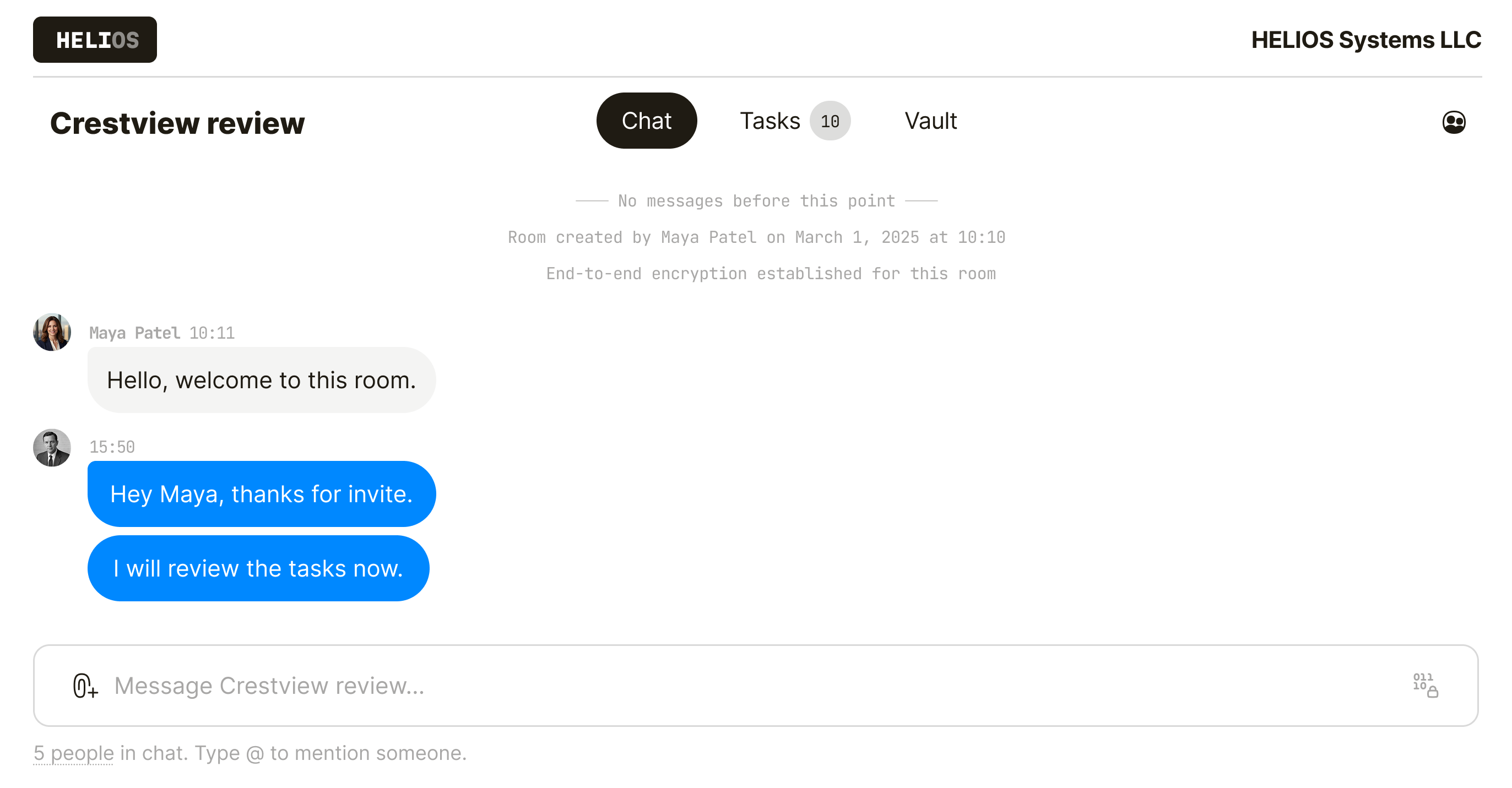
Inside the room, chat keeps questions, decisions, and revisions with the work—instead of scattered across inboxes and side channels.
One private room for one client, one engagement, one case, one deal, one project, or one mandate. Not a broad workspace filled with unrelated activity, but a deliberate room with a clear purpose.
For deal work, this becomes a private deal room: one controlled place for files, questions, revisions, decisions, and next steps.
Inside that room, providers and clients can share files, discuss revisions, assign next steps, record decisions, and keep sign-offs attached to the work itself.
Nothing important has to be spread across different systems. The client does not receive fragments. The provider does not have to chase context. The team does not need to reconstruct what happened later.
Everything lives where it belongs: with the work.
That is why Qaxa is built around rooms, not projects.
A project tracks activity.
A room contains the relationship around the work.
A project tells you that something is moving.
A room tells you what was delivered, what was said, what changed, and what was agreed.
For the final stage of client work, that is the more useful model.
The least protected stage is often the most important
Many tools help teams create work. Far fewer help them deliver it. And almost none treat delivery as the high-stakes moment it really is.
But this is the moment when work leaves the internal circle.
It is when the client sees it.
When revisions begin.
When decisions matter.
When misunderstandings become expensive.
It is also when privacy matters most.
The final stage of work is not a minor administrative step. It is part of the product.
A smooth delivery builds trust.
A messy one weakens it.
A clear review process moves things forward.
A scattered one creates friction.
A secure handoff protects the relationship.
A loose one introduces risk.
That is why Qaxa focuses on the room between provider and client.
That room is not secondary.
It is one of the most important tools in the entire engagement.
Privacy should not be an afterthought
Privacy matters most when real work is being delivered: draft agreements, financial documents, creative assets, internal notes, client comments, approval trails, and handoff materials.
These do not belong in a patchwork of tools held together by links and habit.
They also do not belong in systems where privacy depends on somebody remembering to tick the right box.
Qaxa was built so the room itself is private by default. It is end-to-end encrypted, built around clear boundaries, and designed so the people in the room control the room.
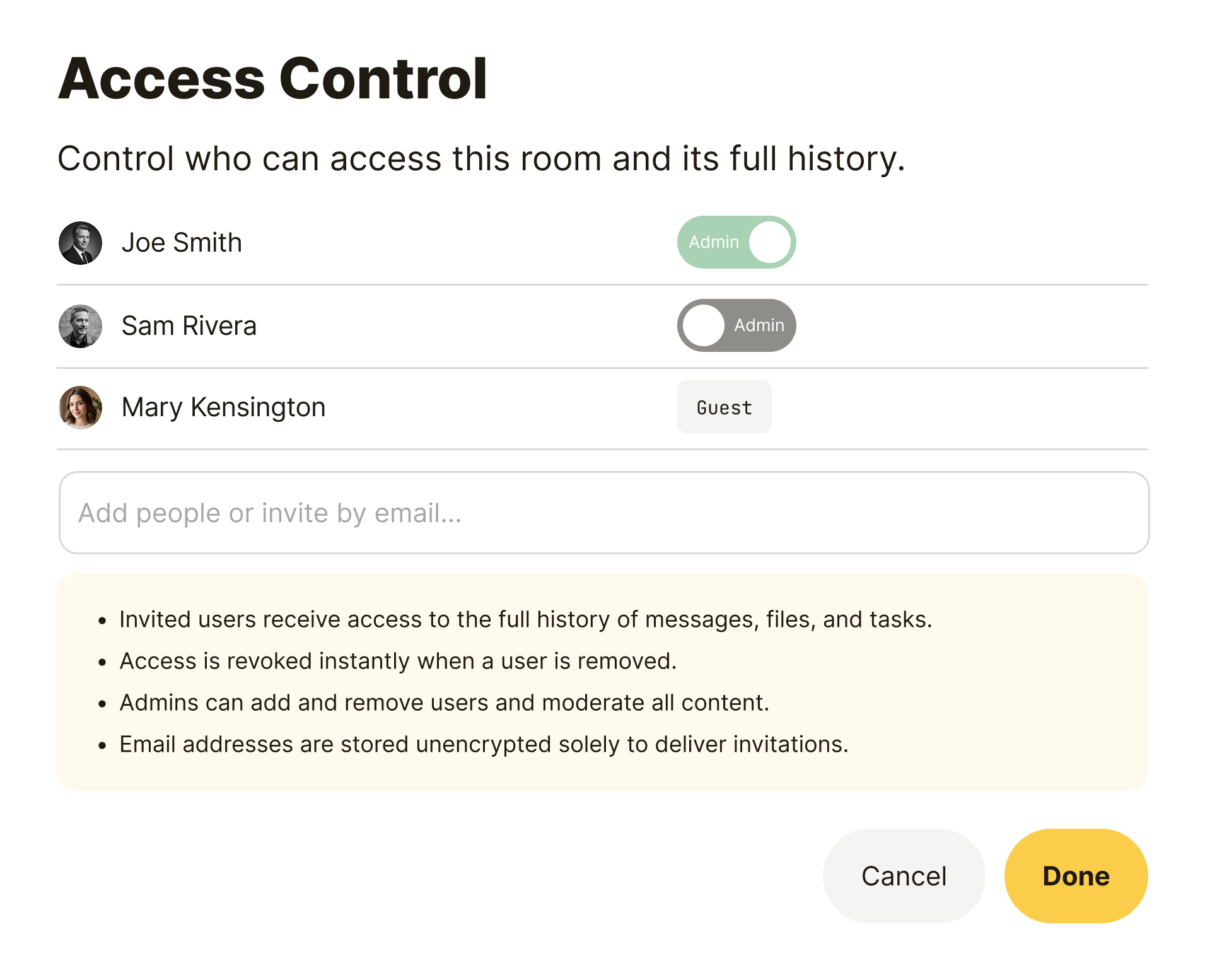
Access stays explicit: control who can enter the room and see its full history.
That does not make the product more complicated.
It makes the promise more credible.
When the work is important, privacy should not depend on good intentions or careful settings. It should already be part of the structure.
What belongs in a delivery room
Everything needed to bring the work to completion belongs in the same place: the current file, the revised file, the question from the client, the provider’s reply, a note on what changed, a task with an owner, a due date, a request for approval, a final sign-off, and a handoff note for what comes next.
In most teams, these pieces are split across several tools simply because that is how the software market evolved. In practice, they belong together.
When context stays attached to the work, people move faster and make fewer mistakes. They do not have to search the inbox. They do not have to guess which file is current. They do not have to ask where the decision was made. They do not have to wonder whether the client saw the latest version. They do not have to reconstruct the approval trail later.
The room holds the full exchange. That is what makes it valuable.
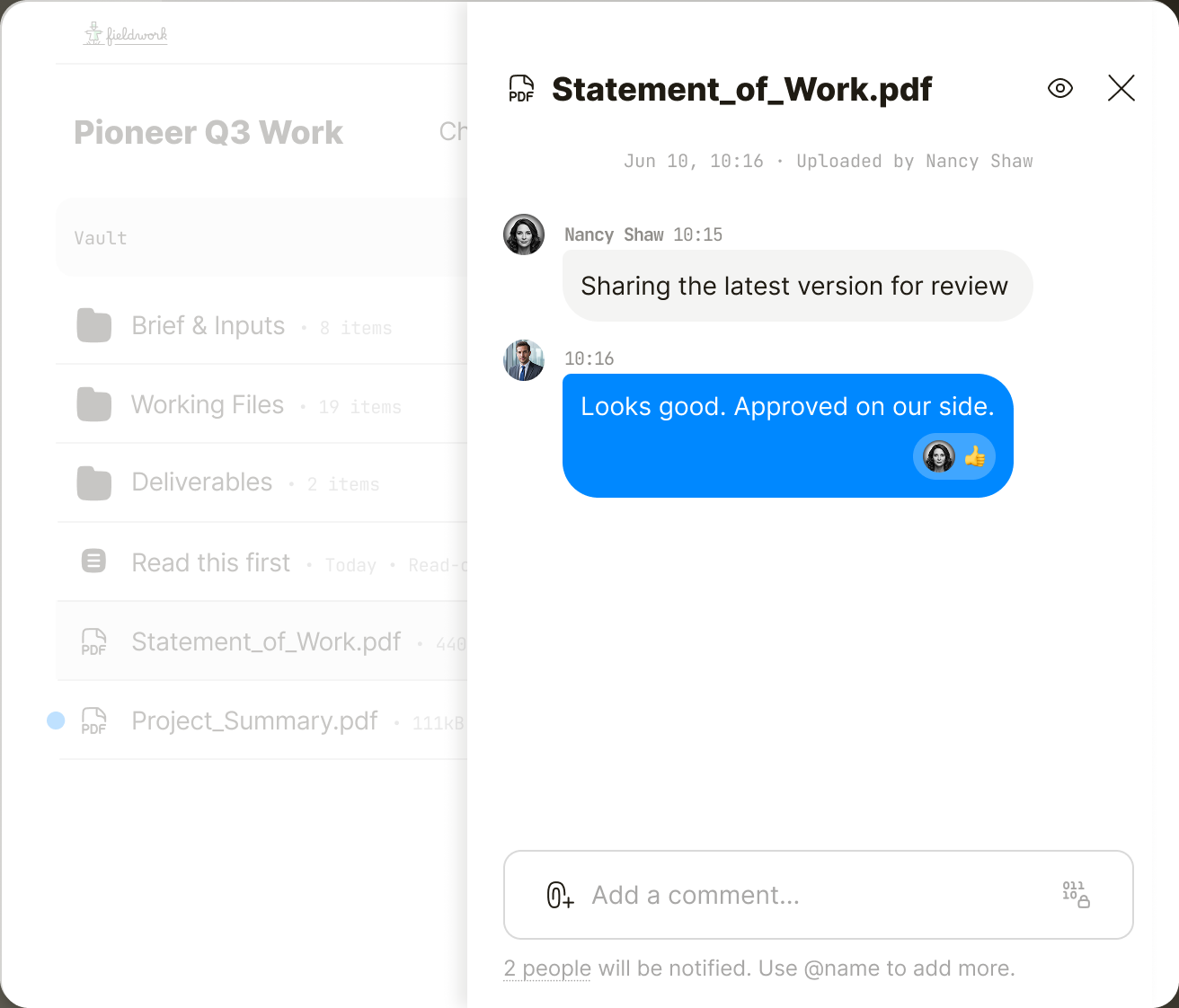
Comments stay attached to the file, so review, approval, and follow-up do not drift into other tools.
This is not for every team
Qaxa is not trying to replace every tool on every desk. It is built for firms, advisors, agencies, consultants, and other professional teams that deliver meaningful work to clients and need the final stage handled properly.
That may be a law firm sharing drafts and collecting comments. It may be an M&A advisor managing review and approvals. It may be an agency delivering creative work and handling revisions. It may be a consultant handing over recommendations and next steps. In each case, the need is the same: one controlled room instead of five disconnected tools.
These teams do not need another feed. They need a room that helps them finish the work well.
Why this matters now
Modern software has trained companies to accept sprawl. One tool for chat. One for files. One for tasks. One for comments. One for signatures. One for client access. Each tool may do its job, but together they make delivery feel harder than it should.
The result is more switching, more duplication, more uncertainty, more room for error, and more time spent managing the process around the work instead of the work itself.
That is expensive in any business. It is even more expensive when the work is confidential, time-sensitive, or tied to trust.
The answer is not another layer on top of the stack. The answer is a better container.
The right way to think about Qaxa
If you think of Qaxa as project management software, you will underestimate it.
If you think of it as a private room between provider and client, the product becomes clear. A room has purpose. A room has boundaries. A room has members. A room holds the work, the conversation, the revisions, and the decisions that belong there.
That is the model behind Qaxa. Simple enough to use every day. Strong enough for serious delivery.
Stop calling it project management
Project management is about tracking work. Qaxa is about bringing work to completion in one private place.
That is a different promise.
Because the real challenge is not only getting the work done. It is delivering it clearly, reviewing it efficiently, keeping feedback attached, recording approvals, protecting the exchange, and finishing the handoff without chaos.
That is not a board. It is not a feed. It is not a shared drive. It is not a portal bolted onto a workflow.
It is a room.
And that is what Qaxa was built to be.